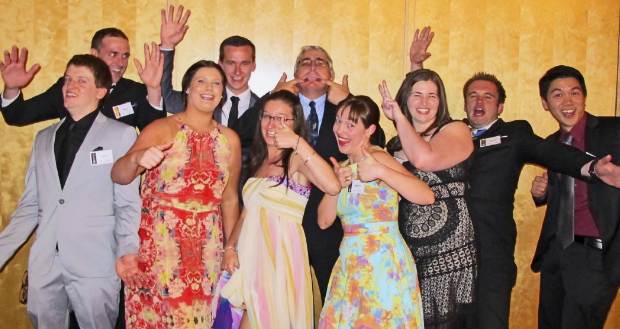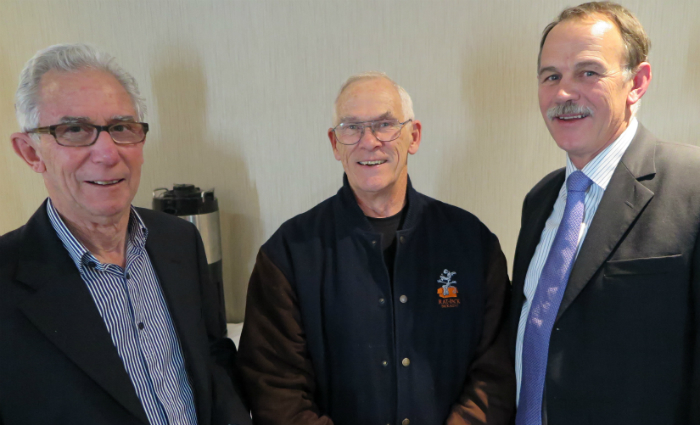
The rich history of Australian lithography was on display around the room of greying offset warriors gathered to relive the glory days at the Lithographic Institute of Australia’s 50th anniversary dinner.
Retired offset veteran Warrick Roden, a founding LIA committee member back in 1963, took the audience through the history of lithography in Australia from its early days, to its overtaking of letterpress as the dominant print standard, and the birth of digital printing.
The LIA was formed to help printers respond to these technological changes, but Roden says it was a rocky start.
“The unions gave us hell and it was perceived first as a ‘bosses club’ and then a ‘sales reps club’,” he says.
“Litho caused lots of upheaval and retraining, but we learned a lot through networking with each other and finding that everyone had the same problems.”
[Related: More offset news]
Through a presentation illustrated by the pages of Fred Stern’s Australian Lithographer magazine, including guffaw-inducing old photos of industry identities, Roden showed the growth and evolution of the industry.
In 1963 there were no Heidelberg litho presses in Australia – by 1972 there were 800. A quarter of a century later computer-to-plate replaced film, and early computers increasingly influenced the operation of presses and print operations.
Roden also regaled the audience with tales of early Australian conventions – at the first one in Katoomba someone almost gassed the audience with ammonia and the second in Geelong had a fire.
“The industry was so vibrant back in the 1960 and ‘70s,” he says.
“People went to drupa to find out where the industry was going, now you pick up the phone, Skype, email, text, or just Google it.
“It goes to show we have to be aware of and embrace changes, or end up like the dinosaurs.”
Fellow retired LIA committee veteran Kevin Thomas told some stories of these early conventions – escapades with girls, booze and poker on trains heading to the event – and told of how he became the last lithography apprentice in NSW before newcomers were instead trained in areas of production.
John Warner recalled how a neighbourhood fire jumped 80 feet across a road to torch the Offset Alpine factory for the first time.
Prepress legend Peter O’Hanlon toasted former members and departed friends.
“Australia was always pushing the limits of lithography – we had the most scanners and five-colour presses per capita in the world,’ he says.
Reflecting on recent developments O’Hanlon says, “I think I got out at the right time.”
The night concluded with a raffle for some tasty Brown Brothers wines, with GAMAA executive director, and only female from the industry in attendance, Karen Goldsmith winning a 2013 Chardonnay and retired old timer Douglas Churchill taking home a fine port.
Comment below to have your say on this story.
If you have a news story or tip-off, get in touch at editorial@sprinter.com.au.
Sign up to the Sprinter newsletter