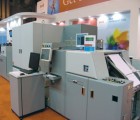
In addition to this Ingede also claimed that output from the HP Indigo electrophotographic presses that used liquid toner were even worse for recycling than inkjet printed output and must be regarded as unrecyclable.
Following drupa I decided to investigate the whole situation of paper recycling and in particular what was the situation of deinking of output from digital presses. The result of this investigation was a paper published on January 12, 2009, that I jointly authored with Ralf Schlözer for Infotrends, entitled Challenges and Strategic Importance of Recycling Digital Print.
In this paper I found that the Ingede comments drew attention to a problem in the area of paper recycling, but also it was one that the digital print suppliers were aware of, and that they were looking at ways of improving how their output worked within the existing deinking and recycling processes.
I also found that output from inkjet printers that used aqueous inks, and from HP Indigo presses, were not the only printed outputs that caused problems in the recycling process. Flexographic printed newspapers were also a serious problem with their aqueous (water based) inks. UV cured offset inks, and certain coatings, glues and varnishes could also cause problems. In the digital printing area there was also a problem with output from Xerox solid ink printers.
In this short article I will not endeavor to explain the reasons why the above printed outputs cause problems with deinking, but will instead outline what is happening in trying to eliminate this problem. Paper recycling is a very significant industry with most recovered paper being used for both newsprint and board production.
An increasing amount of high-grade recovered paper is also used in the provision of recycled office and graphic quality printed papers. In terms of volumes throughout Europe 85% of newsprint from European mills is made only from recycled paper and no virgin pulp from wood is used. More than 50 million tons of used paper is collected each year for use in the recycling process. The overall recycling rate in 2007 for Europe was that 64.5 per cent of all recovered paper was being recycled.
I have had discussions with many people and in particular with a number of HP executives to discuss the situation of deinking covering both inkjet and HP Indigo output. They indicated that HP is committed to be an environmental leader. HP states that is not against changing its ink and HP Indigo ElectroInk formulations, as well as working with the paper industry in changing processes. Considerable research, however, is going ahead in the development of future ElectroInk releases to enhance them for the deinking process.
In the area of inkjet printing with aqueous inks a number of the inkjet printer suppliers have started their own organization. This is the Digital Print De-Inking Alliance (DPDA). The current members of the DPDA are HP, Infoprint Solutions Company, Kodak Graphic Communications Group, and Océ N.V. The DPDA was founded in April 2008 to sponsor focused, objective research to identify printer, paper, or chemical additive solutions (or a combination thereof), ensuring deinking/recycling approaches that are cost-effective and practical as well as that enhance industry sustainability practices. The DPDA is committed to actively engaging all relevant parties: paper manufacturers, paper recyclers, deinking chemical and equipment manufacturers, and researchers, worldwide.
At the present time the situation is still as it was at the time of drupa. Since then a very limited number of high-speed continuous feed inkjet presses have been installed with only one to my knowledge for newspaper production. HP has already demonstrated that the output of its Inkjet Web Press can be deinked, apparently through the use of the binding agent that is printed with the ink.
It is also working with its ColorLok paper technology to enhance deinking of printed output. All of the suppliers of the inkjet presses are working on the problem of deinking and I feel sure that by the time that these presses are being installed in significant numbers the problem of deinking their output will have been solved. I am also sure that HP’s work with future releases of HP Indigo ElectroInk will also help eradicate the deinking problem. I am less sure of the commitment of the newspaper printers using flexographic printing to eradicating the problem of recycling their output. At least it is less likely that newspaper printers will buy further flexographic presses because of environmental pressures.
What about other environmental aspects of digital printing? In general digital printing is environmentally friendly through the ability of just in time printing for items like books rather than warehousing of books printed in large print runs. Such books are frequently unsold and may well be pulped. Digital printing generally has very little in the way of paper wastage. Also most equipment suppliers have good procedures for recovery and recycling of used consumables.
With the current green pressures to conform to strict environmental practices I believe that digital printing is doing an excellent job, and I also see a major commitment from all suppliers to the environment. The message from Ingede at the time of drupa drew attention to problems, but I also find that the industry suppliers were already aware of such problems and were working on procedures to eradicate them.
Comment below to have your say on this story.
If you have a news story or tip-off, get in touch at editorial@sprinter.com.au.
Sign up to the Sprinter newsletter